
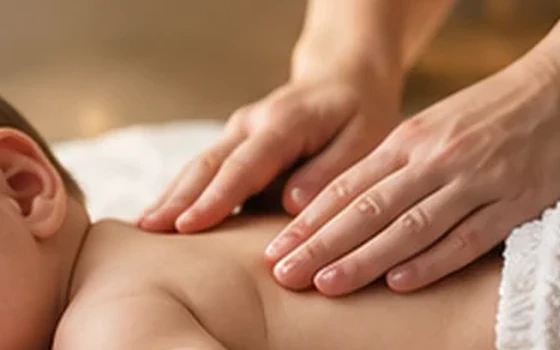
Some babies enjoy gentle touch as part of care, while others prefer less stimulation. Massage is not a way to make every baby sleep on demand. A responsive routine leaves room to stop when the baby signals discomfort or has another need.
Choose a calm moment
Start when the baby is comfortable and alert rather than very hungry, distressed or ready for an urgent feed. Keep the room comfortable and stay within reach throughout. A stable, safe care surface matters more than creating a spa-like setup.
Use gentle contact and watch the response
Keep pressure light and avoid forceful stretching or manipulation. Pause if the baby turns away, stiffens, cries or appears uncomfortable. Ask the pediatrician before massage when a baby is premature, unwell or has a condition affecting safe handling.
Keep products simple
Do not add essential oils or strongly scented products to make the routine seem more effective. Ask about suitable skin care if there is eczema, irritation or another concern. Keep bottles and loose items away from the baby and the sleep space.
Place massage within a short routine
MedlinePlus includes gentle massage among possible calming bedtime activities. It is one option alongside a story or song. A routine can remain brief, and there is no need to complete every activity when feeding or comfort takes priority.
Return to a safe sleep setup
After care, place the baby on their back in a suitable crib or bassinet with a firm, flat mattress and fitted sheet. Remove towels and other care items. Our crib settling guide explains why added padding is not the answer.
Keep comfort ahead of a sleep promise
Gentle touch can be a pleasant part of care, but massage does not guarantee that a baby will sleep longer. Watch the baby's cues: turning away, crying or stiffening may mean they do not want to continue. Choose a calm time when the baby is awake and content, not when urgent feeding or illness needs attention. Ask the pediatrician about any skin condition, prematurity or medical concern before trying a new routine.
Use a safe setup
Place the baby on a stable surface where you can keep one hand on them and never leave them unattended. Avoid strong pressure, essential oils and products not recommended for infant skin. Keep the room comfortable and stop if the baby seems cold or distressed. Massage is an awake-time activity; when the baby is ready to sleep, place them on their back on a firm, flat, clear surface according to NICHD safe-sleep guidance.
Make the routine sustainable
A few calm minutes may fit better than a long prescribed sequence. If one caregiver enjoys the routine and another does not, a different soothing action can also be part of bedtime. Do not use massage to delay addressing pain, feeding problems or persistent distress. Record changes that concern you and ask the baby's clinician for advice. A workable routine supports care without turning each bedtime into a test of whether the technique produced a longer night.
Common questions
A little more clarity.
Must massage make the baby sleepy?
No. Enjoyable interaction can be worthwhile without a guaranteed sleep effect.
Should I continue if the baby cries?
Stop and check what the baby needs rather than treating completion as the goal.
Will massage make every baby sleep?
No. Babies respond differently and sleep depends on many factors.
Can I use essential oil?
Avoid adding products without pediatric guidance, especially on infant skin.
Should massage happen while the baby sleeps?
Treat it as an awake, supervised activity; use a safe sleep surface for sleep.
When should I stop?
Stop if the baby appears distressed, uncomfortable or unwell, and seek advice when needed.