
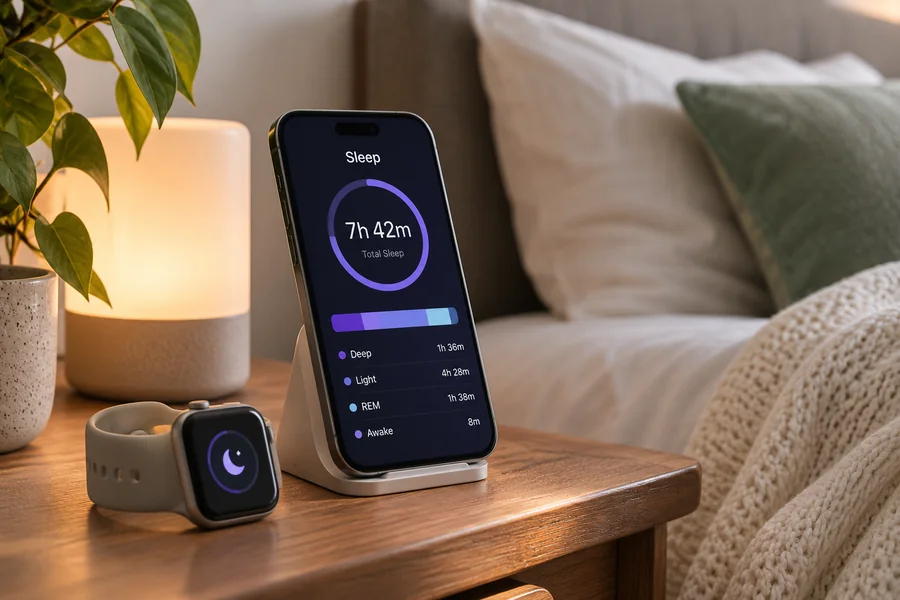
A tracker can be reasonably useful for timing and still misclassify parts of a night. Accuracy is not one property that applies equally to sleep duration, awakenings and every stage. Read the study question before interpreting a headline number.
Separate sleep from sleep stages
Detecting a broad sleep period differs from distinguishing light, deep and REM sleep. Time lying still while awake can be difficult for an algorithm. A precise-looking chart does not eliminate uncertainty about individual intervals.
Check the algorithm being studied
Google’s algorithm research compares particular versions against a clinical reference. Its findings should not be applied indiscriminately to every past or future device. Manufacturer research is useful evidence, but should be identified as such.
Look at the study population
A result from one group may not transfer perfectly to someone with a sleep disorder, irregular schedule or different sensor conditions. Ask whether the validation includes people like you and the outcome you care about. Avoid ranking products from incomparable percentages.
Use trends with context
Record changes in fit, software and wear time. Compare the graph with your own experience rather than treating disagreement as proof that your memory is wrong. Our tracking explainer covers the distinction between sensor signals and clinical measurements.
Do not use a score to dismiss symptoms
Persistent daytime sleepiness, breathing pauses or insomnia warrants advice regardless of a reassuring score. If tracking causes anxiety, consider a simple diary or a break. The point is useful information, not winning a nightly contest.
Define accuracy for the question
Fitbit may estimate when you slept and display stage labels, but those are different claims. Consumer devices do not directly measure brain activity like a clinical sleep study. An algorithm can misclassify quiet wakefulness or brief awakenings. The useful comparison is whether a trend helps you notice a schedule pattern, not whether one nightly percentage is an exact physiological measurement.
Check the conditions of the record
A loose band, depleted battery or synchronization gap can affect the data. Compare several nights under similar wear and settings rather than ranking one unusual night. Read the current model's support information to see which features are available and whether a subscription changes the report. A high sleep score cannot rule out apnea, and a low score alone cannot diagnose insomnia.
Use symptoms as the reason to seek care
If you have persistent sleepiness, loud snoring, gasping or unrefreshing sleep, speak to a clinician. Bring examples of symptoms and, if useful, the device trend as background. CDC guidance emphasizes both sufficient duration and quality. Do not use a wearable chart to change medicine or avoid an evaluation.
Common questions
A little more clarity.
Is every minute of REM on the chart exact?
No. Stages are estimates and individual intervals can be misclassified.
Does a high score rule out sleep apnea?
No. A consumer sleep score is not a diagnostic test.
Does Fitbit measure sleep stages directly?
No. It estimates stages from available sensors and algorithms.
Can I compare my score with a sleep study?
Not as an equivalent diagnostic measurement.
Does a good score rule out a problem?
No. Discuss persistent symptoms with a clinician.
What can the trend help with?
It may prompt a useful look at timing, routines and repeated patterns.
What can I use the tracker for without overinterpreting it?
Use it to notice broad timing patterns: whether bed and wake times shift, how often a record is missing and whether short nights cluster around work or travel. Keep the device, fit and settings similar for comparisons. Do not treat the displayed stages as a clinical measurement or use one score to rule out a problem. If the chart seems inconsistent with your experience, check charging and synchronization and read the current model support information. Bring persistent sleepiness, loud snoring or gasping to a clinician, with the trend as background rather than as a diagnosis.